10 JAVASCRIPT INTERVIEW QUESTIONS

Q-1: What is WeakMap in ES6?
The WeakMap is same as Map where it is a collection of key/value pairs. But in WeakMap, the keys must be objects and the values can be arbitrary values. The object references in the keys are held weakly, meaning that they are a target of garbage collection (GC) if there is no other reference to the object anymore. The WeakMap API is the same as the Map API.
However, One difference to Map objects is that WeakMap keys are not enumerable. And there are no methods giving us a list of keys. If they were, the list would depend on the state of garbage collection, introducing non-determinism. If we want to have a list of keys, we should use a Map.

Q-2: What is Set?
Set objects are collections of unique values. Duplicate values are ignored, as the collection must have all unique values. The values can be primitive types or object references.
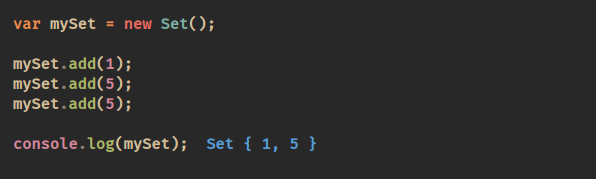
Also, NaN and undefined can also be stored in a Set. NaN is considered the same as NaN (even though NaN !== NaN).
Q-3: What is Generator function?
Generator functions are a new feature in ES6 that allow a function to generate many values over time by returning an object which can be iterated over to pull values from the function one value at a time.
A generator function returns an iterable object when it’s called. It is written using the new * syntax as well as the new yield keyword introduced in ES6.
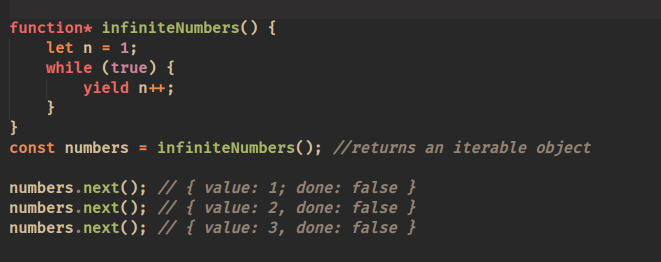
Each time yield is called, the yielded value becomes the next value in the sequence. Also, note that generators compute their yielded values on demand, which allows them to efficiently represent sequences that are expensive to compute, or even infinite sequences.
Q-4: What is WeakSet?
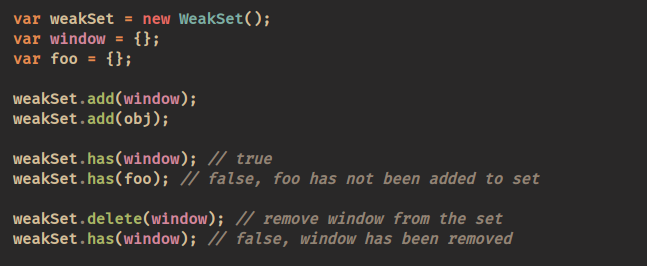
The WeakSet object lets you store weakly held objects in a collection.
WeakSet objects are collections of objects. An object in the WeakSet may occur only once; it is unique in the WeakSet's collection. The main differences to the Set object are:
- Unlike Set, WeakSets are collections of objects only and not of arbitrary values of any type.
- The WeakSet is weak: References to objects in the collection are held weakly. If there is no other reference to an object stored in the WeakSet, they can be garbage collected. That also means that there is no list of current objects stored in the collection. WeakSets are not enumerable.
Q-5: What will be the output of the code below?

The output would be 5. When we use the delete operator to delete an array element, the array length is not affected from this. This holds even if you deleted all elements of an array using the delete operator.
In other words, when the delete operator removes an array element, that deleted element is not longer present in array. In place of value at deleted index undefined x 1 in chrome and undefined is placed at the index. If you do console.log(trees) output ["xyz", "xxxx", "test", undefined × 1, "apple"] in Chrome and in Firefox ["xyz", "xxxx", "test", undefined, "apple"]
Q-6: How can we calculate the length of the above associative array’s counterArray?
There are no in-built functions and properties available to calculate the length of associative array object here. However, there are other ways by which we can calculate the length of an associative array object. In addition to this, we can also extend an Object by adding a method or property to the prototype in order to calculate length. However, extending an object might break enumeration in various libraries or might create cross-browser issues, so it's not recommended unless it's necessary. Again, there are various ways by which we can calculate length.
Object has the keys method which can be used to calculate the length of an object:
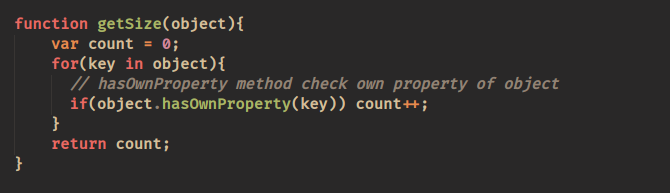
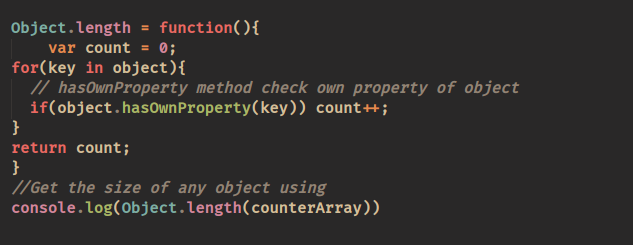
We can also add a length method directly on Object:
Q-7: How do you add an element at the begining of an array? How do you add one at the end?

Q-8: What will the following code output and why?
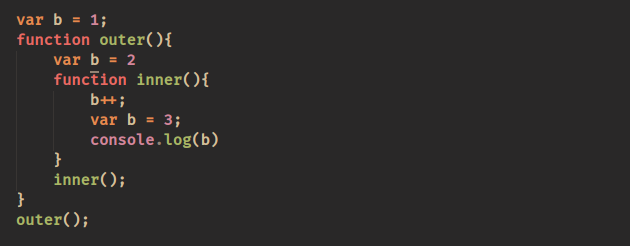
Output to the console will be “3”.
There are three closures in the example, each with it’s own var b declaration. When a variable is invoked closures will be checked in order from local to global until an instance is found. Since the inner closure has a b variable of its own, that is what will be output.
Furthermore, due to hoisting the code in inner will be interpreted as follows:

Q-9: What is NaN? What is its type? How can you reliably test if a value is equal to NaN?
The NaN property represents a value that is “not a number”. This special value results from an operation that could not be performed either because one of the operands was non-numeric (e.g., "abc" / 4), or because the result of the operation is non-numeric.
While this seems straightforward enough, there are a couple of somewhat surprising characteristics of NaN that can result in hair-pulling bugs if one is not aware of them.
For one thing, although NaN means “not a number”, its type is, believe it or not, Number:
console.log(typeof NaN === "number"); // logs "true"
Additionally, NaN compared to anything – even itself! – is false:
console.log(NaN === NaN); // logs "false"
A semi-reliable way to test whether a number is equal to NaN is with the built-in function isNaN(), but even using isNaN() is an imperfect solution.
A better solution would either be to use value !== value, which would only produce true if the value is equal to NaN. Also, ES6 offers a new Number.isNaN() function, which is a different and more reliable than the old global isNaN() function.
Q-10: What is the significance, and what are the benefits, of including 'use strict' at the beginning of a JavaScript source file?
The short and most important answer here is that use strict is a way to voluntarily enforce stricter parsing and error handling on your JavaScript code at runtime. Code errors that would otherwise have been ignored or would have failed silently will now generate errors or throw exceptions. In general, it is a good practice.
Some of the key benefits of strict mode include:
- Makes debugging easier. Code errors that would otherwise have been ignored or would have failed silently will now generate errors or throw exceptions, alerting you sooner to problems in your code and directing you more quickly to their source.
- Prevents accidental globals. Without strict mode, assigning a value to an undeclared variable automatically creates a global variable with that name. This is one of the most common errors in JavaScript. In strict mode, attempting to do so throws an error.
- Eliminates this coercion. Without strict mode, a reference to a this value of null or undefined is automatically coerced to the global. This can cause many headfakes and pull-out-your-hair kind of bugs. In strict mode, referencing a a this value of null or undefined throws an error.
- Disallows duplicate parameter values. Strict mode throws an error when it detects a duplicate named argument for a function (e.g., function foo(val1, val2, val1){}), thereby catching what is almost certainly a bug in your code that you might otherwise have wasted lots of time tracking down.
- Note: It used to be (in ECMAScript 5) that strict mode would disallow duplicate property names (e.g. var object = {foo: "bar", foo: "baz"};) but as of ECMAScript 2015 this is no longer the case.
- Makes eval() safer. There are some differences in the way eval() behaves in strict mode and in non-strict mode. Most significantly, in strict mode, variables and functions declared inside of an eval() statement are not created in the containing scope (they are created in the containing scope in non-strict mode, which can also be a common source of problems).
- Throws error on invalid usage of delete. The delete operator (used to remove properties from objects) cannot be used on non-configurable properties of the object. Non-strict code will fail silently when an attempt is made to delete a non-configurable property, whereas strict mode will throw an error in such a case.